I am a Doctoral researcher in the Complex Adaptive Systems Lab at the University of Central Florida, advised by Dr. Niloofar Yousefi. My research is about reliable LLMs when humans can't supervise at scale. (1) Can pretrained transformers report calibrated uncertainty in their own attention? (2) Can we verify AI-generated supervision when judges share blind spots? (3) Can we monitor tool-using agents and intervene on unsafe trajectories, not just outputs? All three assume a model I cannot retrain, the access most deployed systems allow. So the work is inference-time or training-free, tested under adversarial input and distribution shift. I also build language models from scratch. My applied vertical is clinical and biomedical AI, where confident errors cost patient harm, not benchmark points. I write on Medium as well.
-
Test-Time Uncertainty in Pretrained Transformers
- Uncertainty-aware attention at inference time, without retraining.
- Confidence calibrated enough to route clinical cases to a human.
- Abstain under a fixed risk budget rather than answer every input.
-
Reliable AI Supervision
- Independent agents verify preference labels before RLHF or DPO.
- What judge agreement is worth when the judges are not independent.
- Oversight that still holds when the supervisor is itself a model.
-
Runtime Safety and Evaluation for LLM Agents
- Inspect an agent's plan, then allow, block, confirm, or revise.
- Gate inter-agent channels so poisoned output carries no instructions.
- Score the trajectory a clinical agent takes, not just its answer.
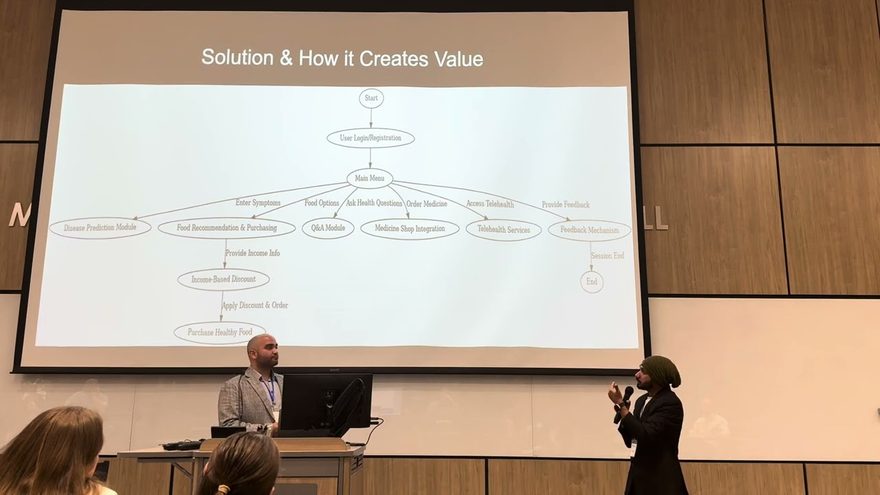
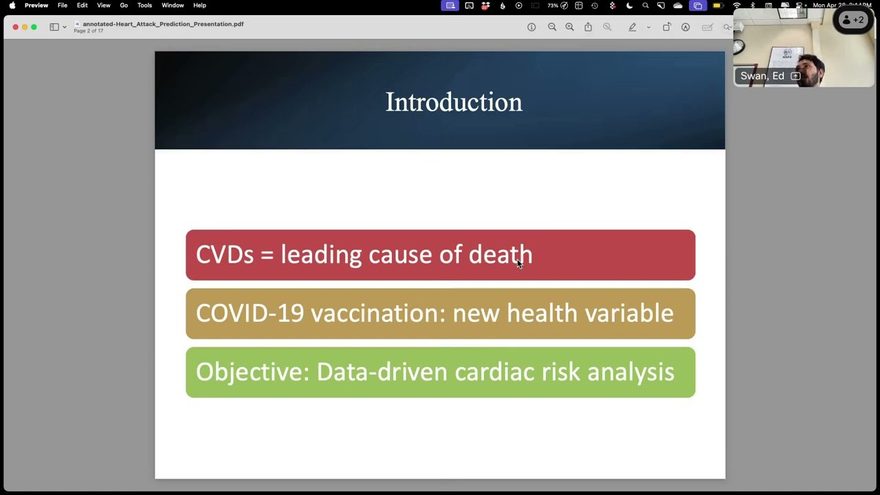
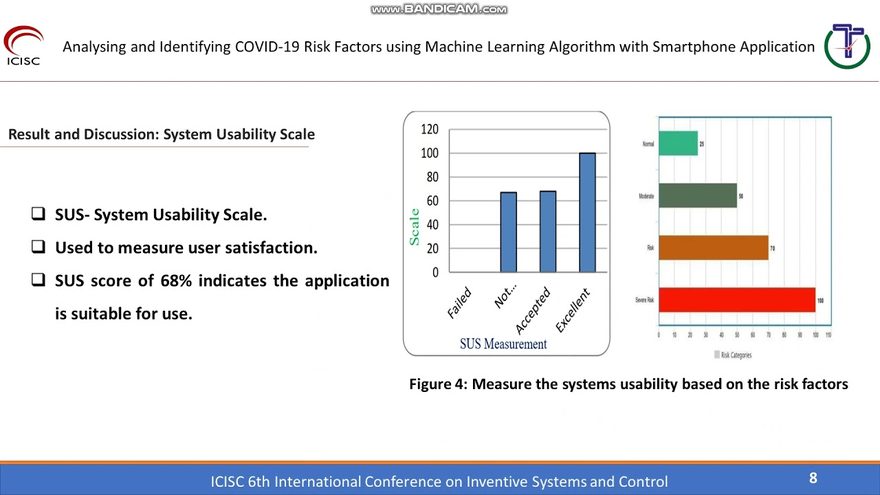
Conferences and talks
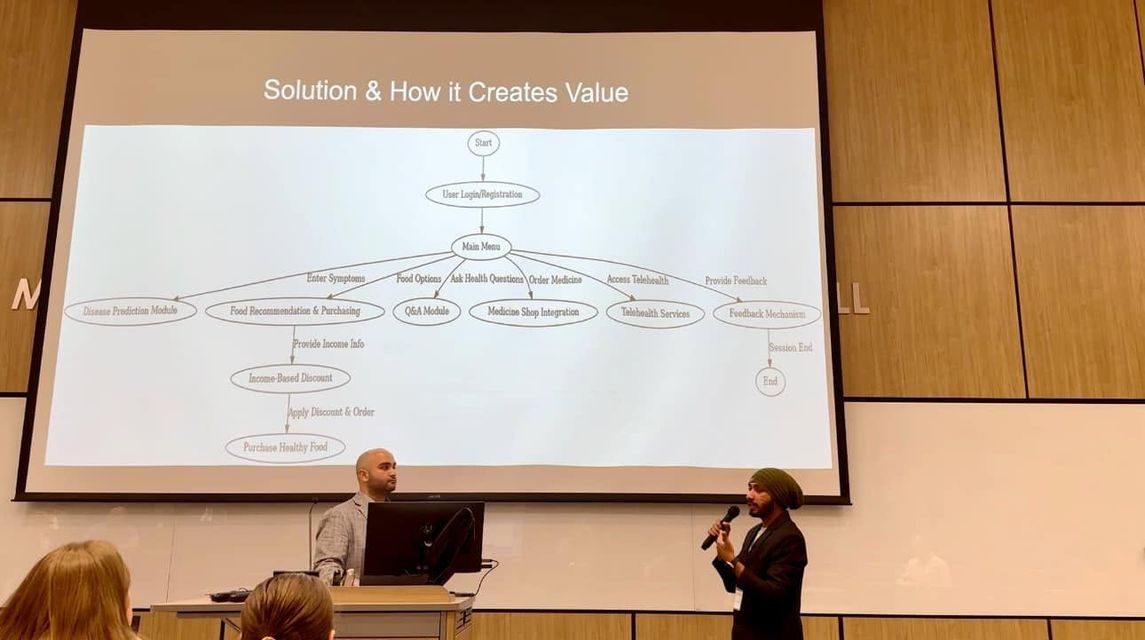
Invited talk on AI in healthcare and what it can mean for rural America.
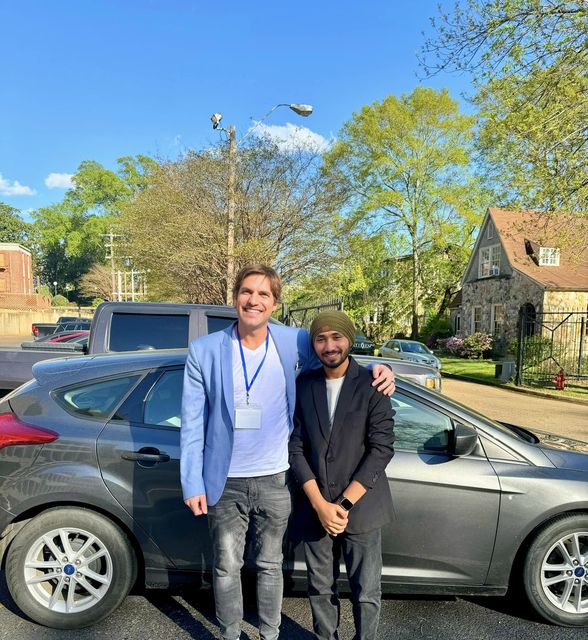
With Professor David.

Molecular Machine Learning Conference, Cambridge.
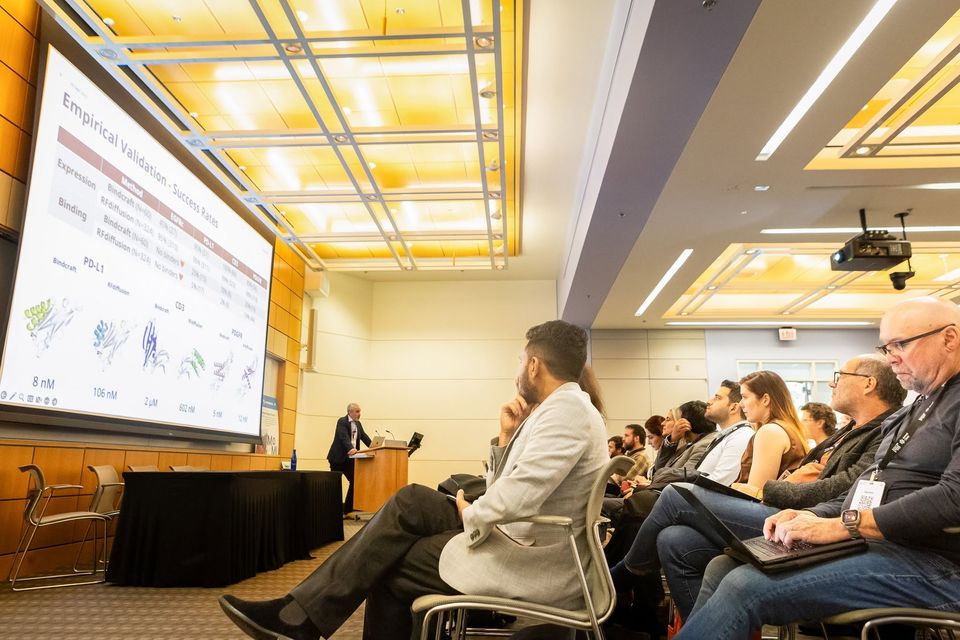
Molecular Machine Learning Conference, Cambridge.
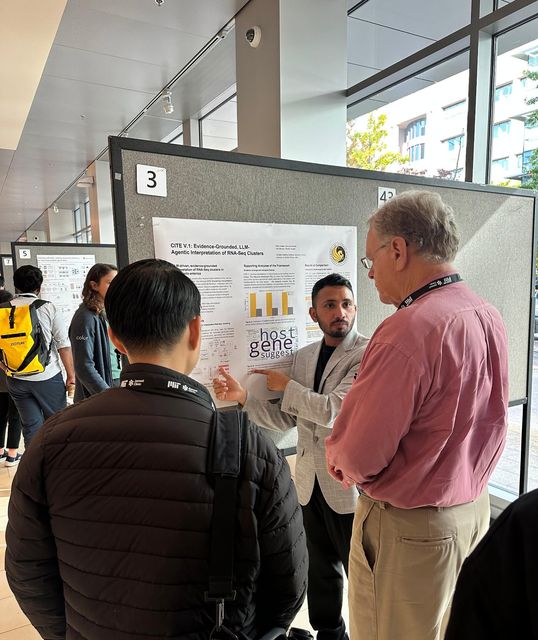
Molecular Machine Learning Conference, Cambridge.
Who I work with
I work with researchers who have led or built AI at Meta, Google AI, Intel, Amazon, and GE Research, alongside academic and clinical groups on three continents.
Featured Publications
Check out Google Scholar for a full list of my publications.
When Policies Cannot Be Retrained: A Unified Closed-Form View of Post-Training Steering in Offline Reinforcement Learning
Deployment objectives change after training, but the actor often cannot be retrained. Composing a frozen offline RL actor with a goal-conditioned prior as a product of experts yields the same policy as KL-regularized adaptation, with β = α/(1−α) for diagonal-Gaussian actors. The result is graceful degradation rather than universal gain: across four D4RL environments the HELP/FROZEN/HURT split is 4/5/3, and under a degraded prior the composition stays anchored to the frozen actor while additive and prior-only adaptation collapse.
@inproceedings{hossain2026policies,
  title={When Policies Cannot Be Retrained: A Unified Closed-Form View of Post-Training Steering in Offline Reinforcement Learning},
  author={Hossain, Elias and Basher, Mohammad Jahid Ibna and Garibay, Ivan and Garibay, Ozlem and Yousefi, Niloofar},
  booktitle={Advances in Neural Information Processing Systems},
  year={2026}
}
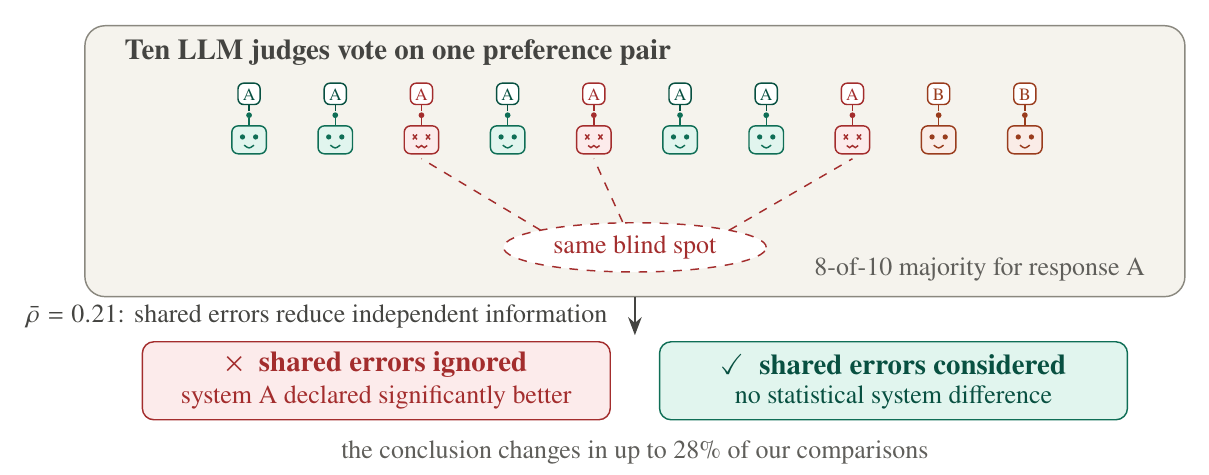 Full figure
Agreement Overstates Evidence: Error Dependence in LLM Judge Consensus
Consensus among LLM judges assumes they fail independently. They do not: in a ten-judge bank the mean error correlation is 0.21, so the votes carry the evidence of about 3.5 independent judges, frontier judges from different providers are even more correlated (0.56), and ignoring the dependence flips significance conclusions in up to 28% of comparisons. A small trusted set is enough to estimate the dependence and choose the voting rule.
 Full figure
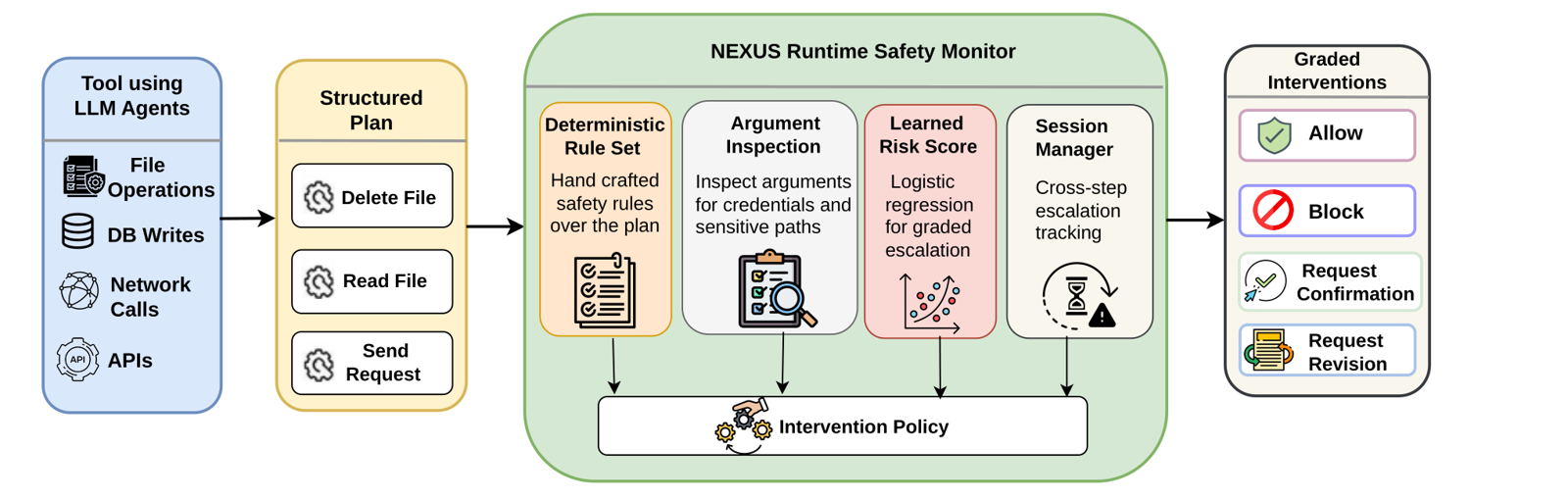
NEXUS: Structured Runtime Safety for Tool-Using LLM Agents
A structured-plan safety monitor that chooses among four interventions, allow, block, request confirmation, or request revision, by combining deterministic rules, argument-level inspection, and a calibrated risk score for graded escalation. Reaches 0.949 F1 while adding 0.205 ms median latency, under 0.1% overhead on a typical agent loop.
@inproceedings{hossain2026nexus,
  title={NEXUS: Structured Runtime Safety for Tool-Using LLM Agents},
  author={Hossain, Elias and Nipu, Md Mehedi Hasan and Ornee, Tasfia Nuzhat and Rana, Rajib and Yousefi, Niloofar},
  booktitle={Findings of the Association for Computational Linguistics: AACL-IJCNLP 2026},
  year={2026}
}
 Full figure
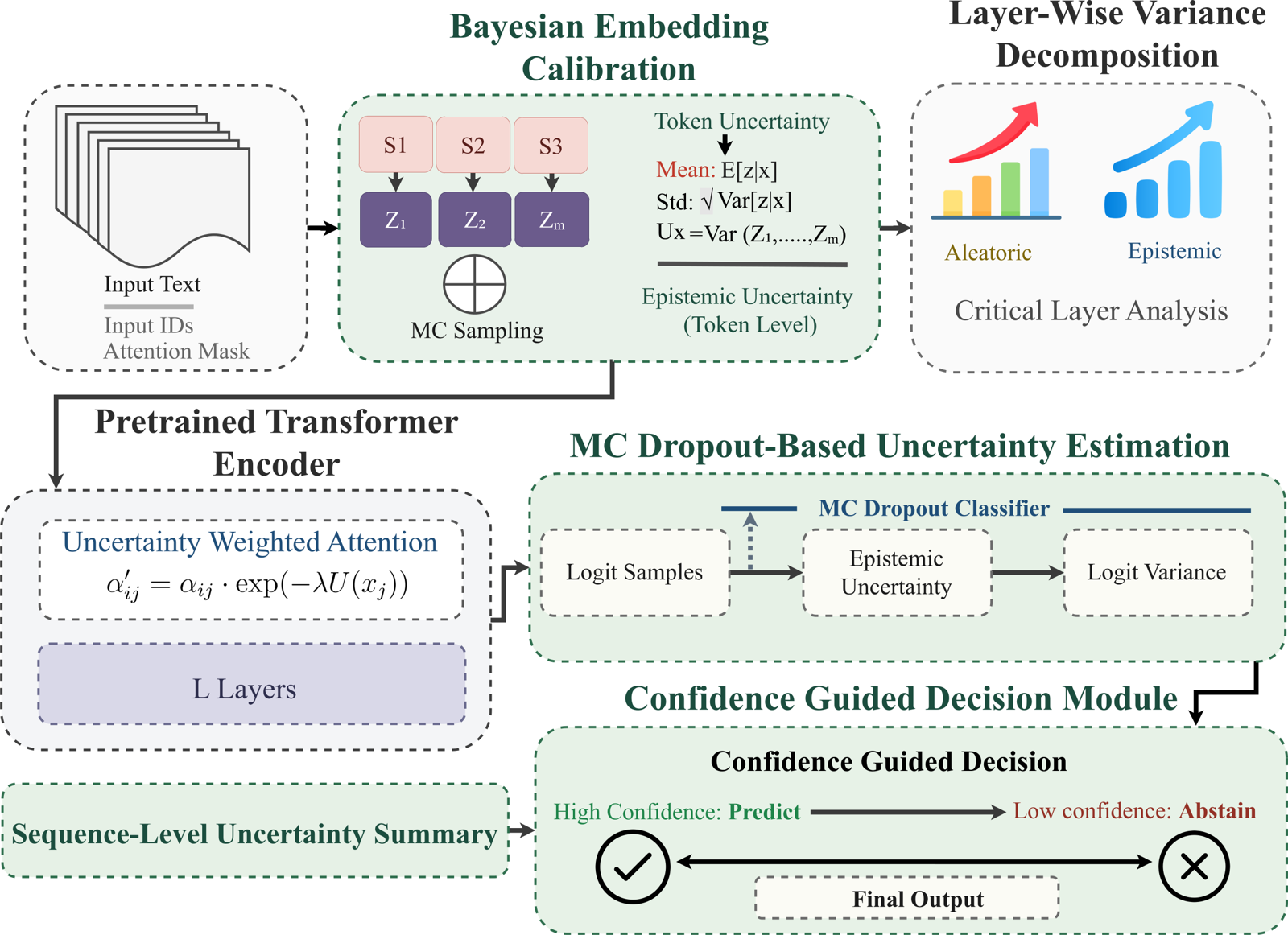
UAT-LITE: Inference-Time Uncertainty-Aware Attention for Pretrained Transformers
Inference-time method that uses Monte-Carlo dropout to make pretrained transformer attention uncertainty-aware. Improves calibration, selective prediction, and robustness without retraining.
@article{hossain2026uatlite,
  title={UAT-LITE: Inference-Time Uncertainty-Aware Attention for Pretrained Transformers},
  author={Hossain, Elias and Dipta, Shubhashis Roy and Neupane, Subash and Rana, Rajib and Shwartz-Ziv, Ravid and Garibay, Ivan and Yousefi, Niloofar},
  journal={arXiv preprint arXiv:2602.02952},
  year={2026}
}
 Full figure
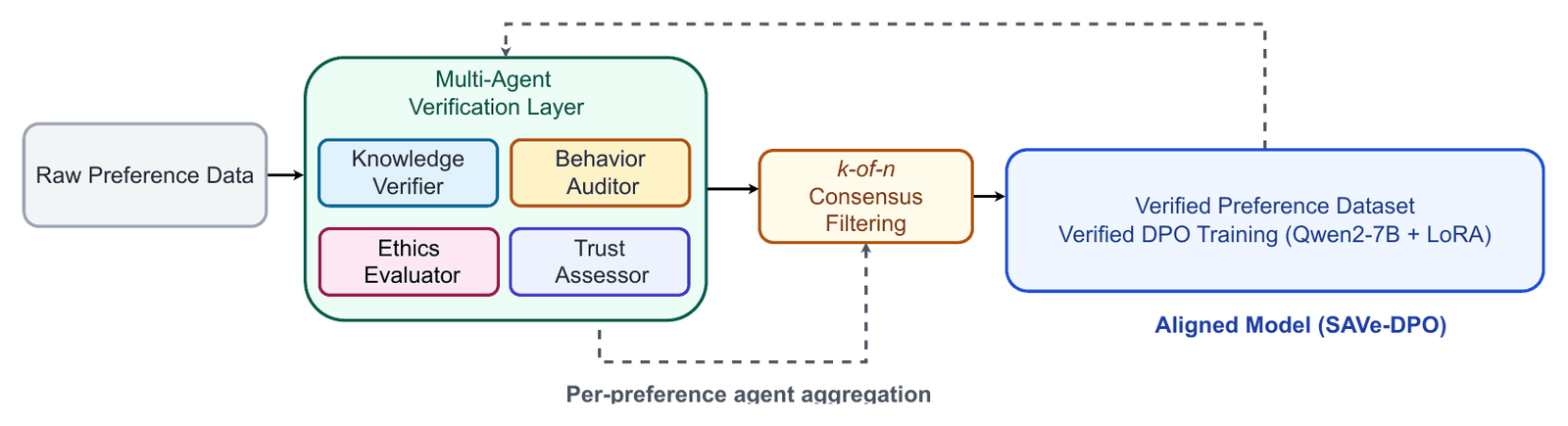
Fault-Tolerant Preference Alignment via Multi-Agent Verification
RLHF and DPO both assume the preference data is trustworthy. MPV drops that assumption: four verifier agents check every preference pair for factuality, safety, ethics, and trust, and only pairs clearing a k-of-n vote reach training. Consensus provably suppresses corrupted supervision at an exponential rate, and on Qwen2-7B it cuts the summarization refusal rate from 0.148 to 0.005 while holding win-rate at parity.
@inproceedings{hossain2026mpv,
  title={Fault-Tolerant Preference Alignment via Multi-Agent Verification},
  author={Hossain, Elias and Rahimimovassagh, Maryam and Neupane, Subash and Basher, Mohammad Jahid Ibna and Garibay, Ivan and Yousefi, Niloofar},
  booktitle={ICLR 2026 Workshop on Principled Design for Trustworthy AI},
  year={2026},
  url={https://openreview.net/forum?id=u73knIzvbY}
}
 Full figure
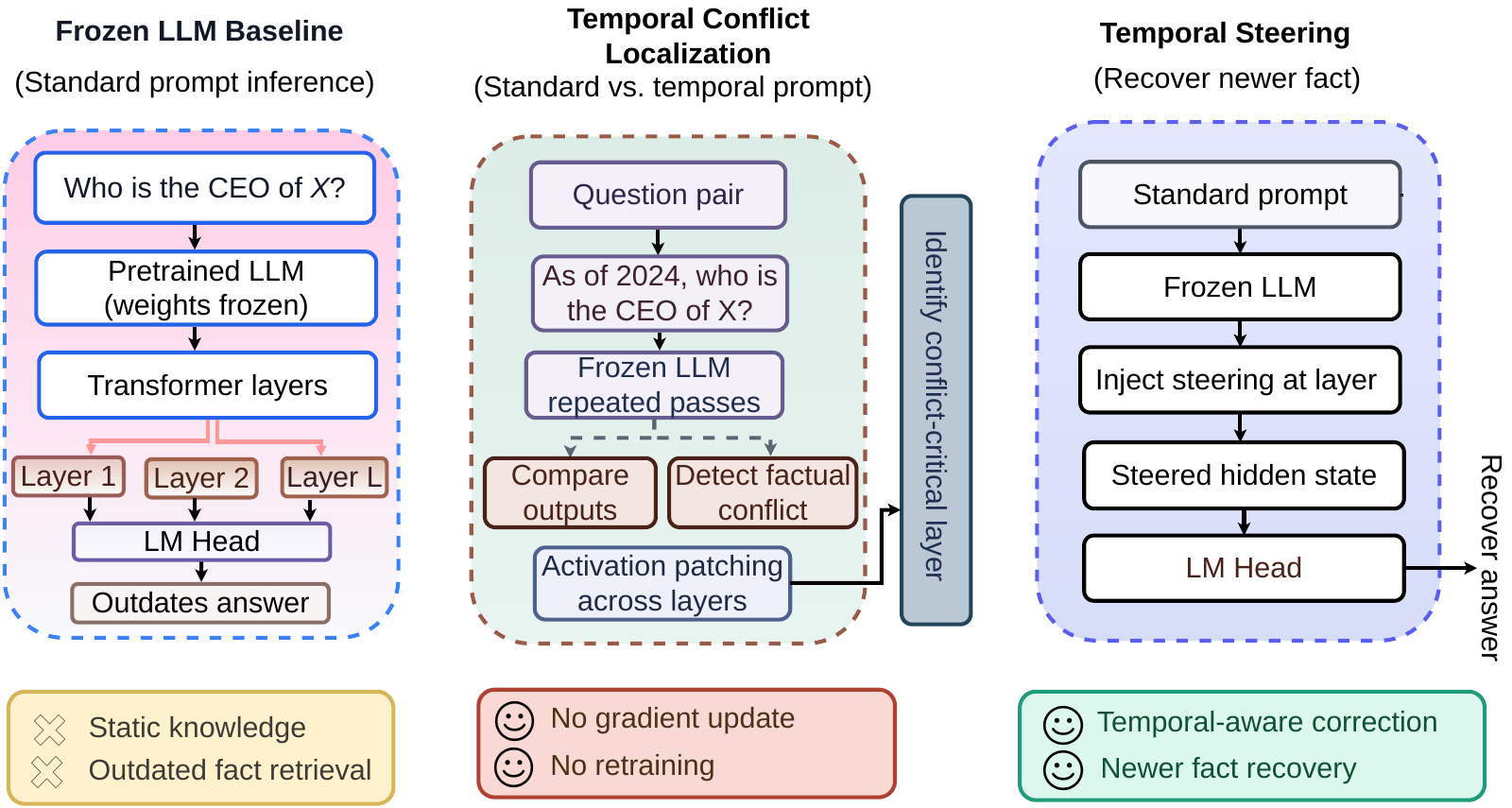
Right Knowledge, Wrong Answer: Characterizing Parametric Temporal Conflict in Open-Weight Language Models
Introduces Parametric Temporal Conflict, where a model holds the newer fact but its default forward pass still prefers the outdated one. On a verified benchmark of 8,746 Wikidata transitions, a date-prefix prompt recovers the newer fact in 61–81% of cases and activation patching flips 72–85%, localizing the preference to model-specific upper layers rather than missing knowledge.
@article{hossain2026rightknowledge,
  title={Right Knowledge, Wrong Answer: Characterizing Parametric Temporal Conflict in Open-Weight Language Models},
  author={Hossain, Elias and Saha, Sourav and Ornee, Tasfia Nuzhat and Jennifer, Sanjeda Sara and Biswas, Umesh Chandra and Dipta, Shubhashis Roy and Rana, Rajib and Yousefi, Niloofar},
  journal={arXiv preprint arXiv:2606.20959},
  year={2026}
}
 Full figure
ChannelGuard: Safe Models Do Not Compose into Safe Multi-Agent Systems
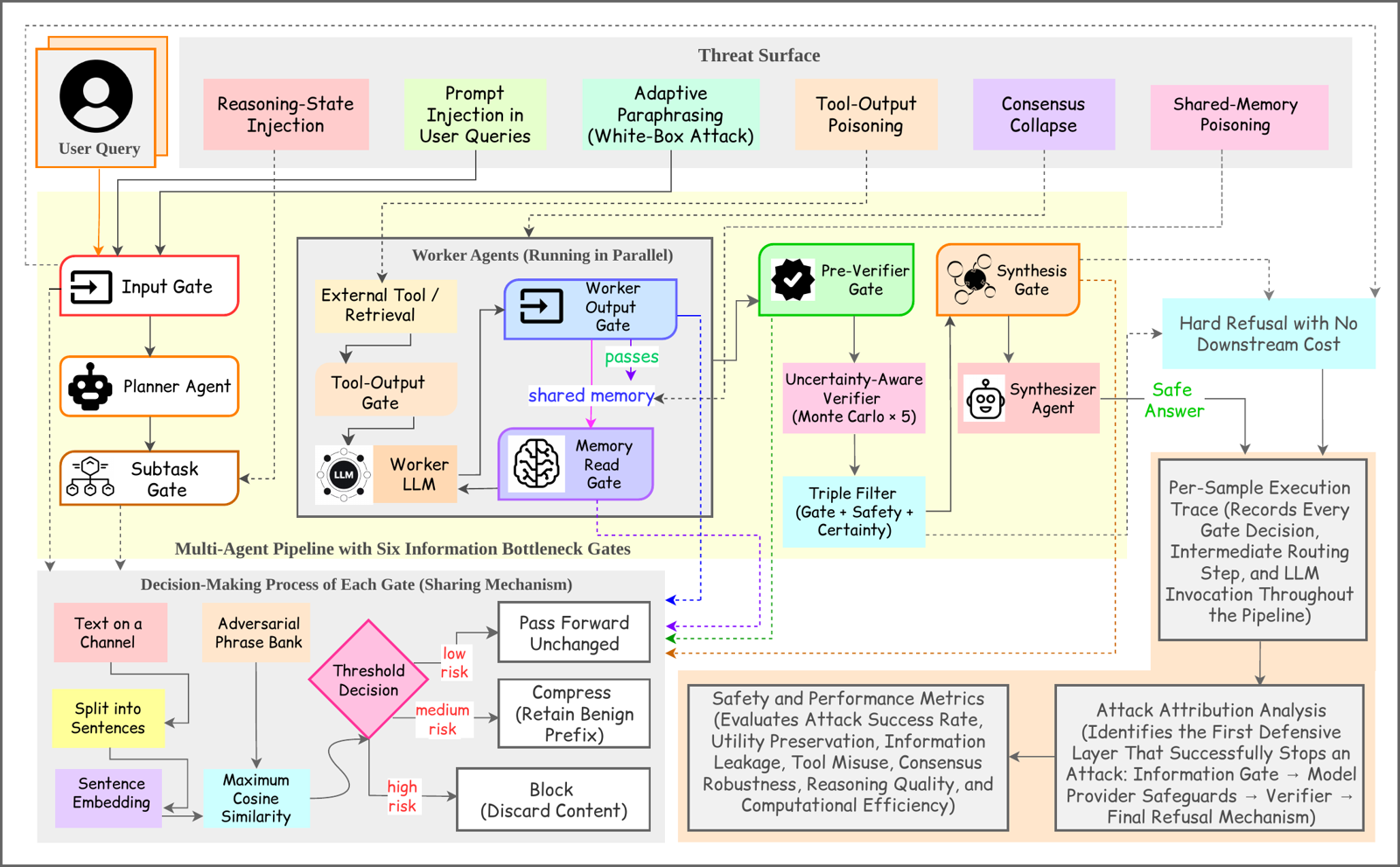
Across 2,100 test cases and eight attack families, the apparent safety of multi-agent LLM pipelines often rests on opaque provider filters rather than the system itself. ChannelGuard places training-free information-bottleneck gates on every inter-agent channel, blocking tool-output poisoning outright and halving prompt-injection success while holding task accuracy at 0.867.
@article{hossain2026channelguard,
  title={ChannelGuard: Safe Models Do Not Compose into Safe Multi-Agent Systems},
  author={Hossain, Elias and Nipu, Md Mehedi Hasan and Faria, Fatema Tuj Johora and Ornee, Tasfia Nuzhat and Sheikh, Maleeha},
  journal={arXiv preprint arXiv:2607.19430},
  year={2026}
}
Safe and Scalable Collaboration in Multiagent LLM Systems: A Comprehensive Review
A review of large language model based multiagent ecosystems, covering how agents coordinate, communicate, and reason across distributed settings, and what fails as those systems scale. Organized around four foundational pillars of multiagent LLM design, it maps the safety and scalability gaps that separate working demonstrations from deployable systems.
@article{hossain2026safescalable,
  title={Safe and Scalable Collaboration in Multiagent LLM Systems: A Comprehensive Review},
  author={Hossain, Elias and Nipu, Md. Mehedi Hasan Bhuiyan and Mahmood, Mohammad Sakib and Hossen, Md. Jakir and Mridha, M. F.},
  journal={IEEE Transactions on Systems, Man, and Cybernetics: Systems},
  pages={1--17},
  year={2026},
  doi={10.1109/TSMC.2026.3704902}
}
 Full figure
BIOGEN: Evidence-Grounded Multi-Agent Reasoning for Transcriptomic Interpretation in Antimicrobial Resistance
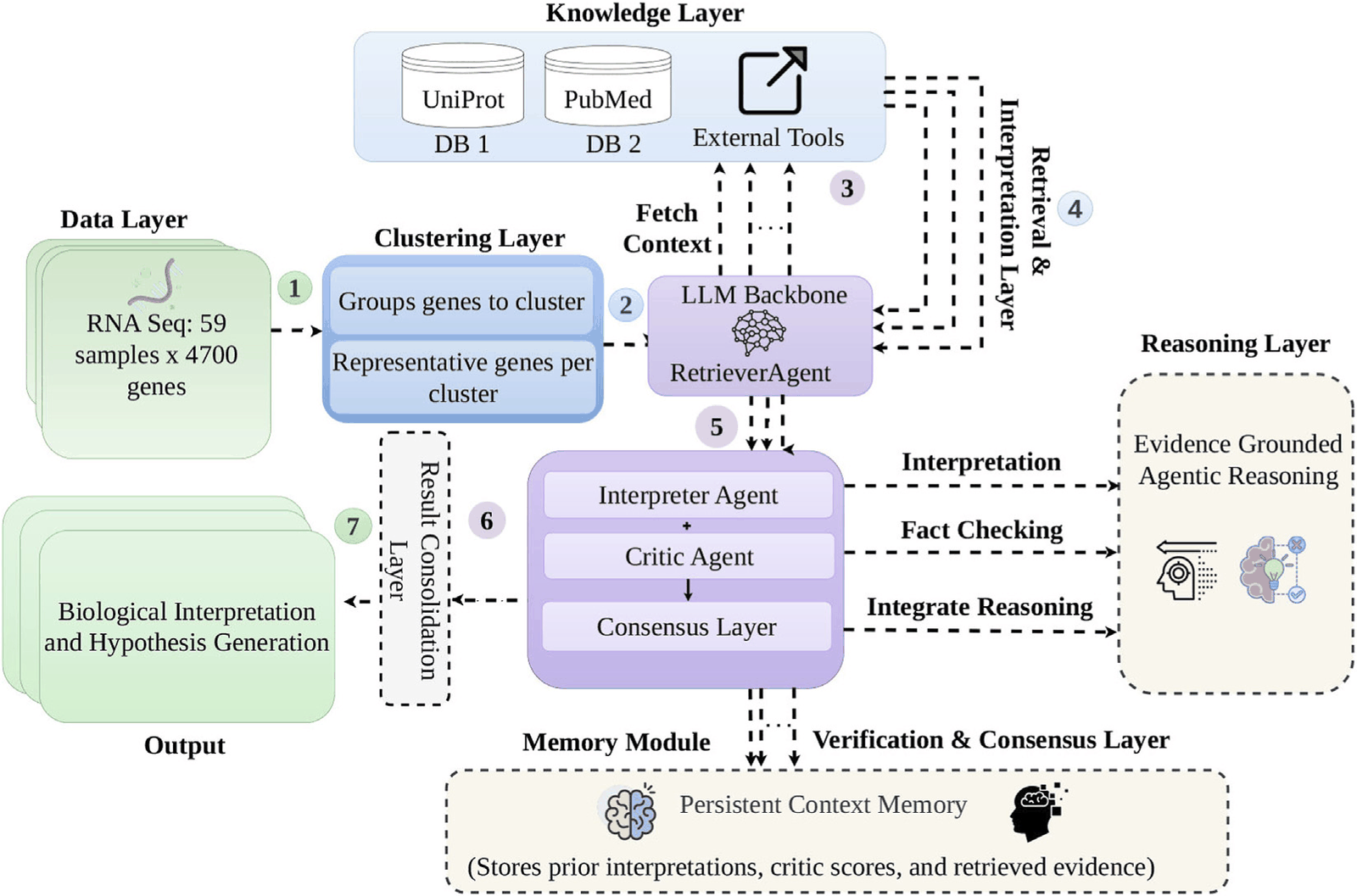
A multi-agent framework that interprets RNA-seq gene clusters by pairing retrieval over PubMed and UniProt with an interpreter agent and a three-way critic ensemble. Every claim carries a verifiable identifier: the non-verifiable identifier rate is 0.000 against 0.100 for an LLM-only baseline, and BIOGEN is the only system holding that rate at zero across all five bacterial datasets, including under cross-organism and cross-condition shift.
@article{hossain2026biogen,
  title={BIOGEN: evidence-grounded multi-agent reasoning framework for transcriptomic interpretation in antimicrobial resistance},
  author={Hossain, Elias and Shoeibi, Mehrdad and Garibay, Ivan and Yousefi, Niloofar},
  journal={Frontiers in Bioinformatics},
  volume={6},
  pages={1846404},
  year={2026},
  doi={10.3389/fbinf.2026.1846404}
}