Explainer
The paper in one minute
A narrated one-minute walkthrough. The full NeurIPS 2026 talk recording will be added here after the conference; until then, the poster and slides are on the NeurIPS 2026 page.
A Unified Closed-Form View of Post-Training Steering in Offline Reinforcement Learning
Complex Adaptive Systems Laboratory, Department of Industrial Engineering and Management Systems, University of Central Florida
*Corresponding authors
An offline RL actor has been trained and approved, then the deployment objective changes and the actor cannot be retrained. We steer it at deployment by composing it with a goal-conditioned prior as a Product of Experts. For diagonal-Gaussian policies this is exactly the same deterministic policy as KL-regularized adaptation with β = α/(1−α). Its real value is graceful degradation: when the prior is bad, it stays with the frozen actor, while additive and prior-only adaptation collapse. Its limit is the actor itself: steering can help or preserve a competent actor, can hurt one near its ceiling, and cannot rescue one that fails.
A narrated one-minute walkthrough. The full NeurIPS 2026 talk recording will be added here after the conference; until then, the poster and slides are on the NeurIPS 2026 page.
Offline RL methods handle objective change during training, through conservative value estimates or behavior regularization. A common deployment situation is left out: the actor has already been trained and validated, the objective is revised afterwards, and changing the actor is not an option because data access is limited, retraining is expensive, or every policy change has to go back through governance and revalidation.
A diagonal-Gaussian actor πθ(a | s), trained once by behavioral cloning on a fixed D4RL dataset, then frozen. Its parameters are never touched again.
The deployment goal g weights three reward channels recovered from the dataset (forward progress, control magnitude, alive), giving rg(s,a) = g · rc(s,a). We test speed, balanced, and control-weighted goals.
A goal-conditioned prior ρφ(a | s,g), trained on the same offline data with goal-weighted BC plus a contrastive ranking term. It reweights dataset actions and never queries a critic.
The deployed policy is the frozen actor multiplied by the prior, with one knob α ∈ [0,1] trading conservatism for adaptation. α → 1 gives back the frozen actor; α → 0 gives the prior restricted to actions the actor supports. In finite action spaces the product never puts mass where the actor puts none.
This is the unique maximizer of an entropy-regularized objective, equivalently argminπ [ α KL(π‖πθ) + (1−α) KL(π‖ρφ) ], the KL barycenter of actor and prior (Theorem 1).
A precision-weighted average. A confident prior moves the action; a diffuse one barely does. This is where the robustness comes from.
The familiar frozen-actor trust-region update. Treated as a separate mechanism in prior work, but for diagonal Gaussians it is the same deterministic policy as PoE once β = α/(1−α).
The natural parameters are scalar multiples, so the means coincide exactly and the covariances differ by the global factor 1/α, which cancels under deterministic (mean-action) deployment. The Gaussian algebra is standard. What the paper adds is making the identity explicit for frozen-actor deployment and organizing the empirical study around it. The grid α ∈ {0.1, 0.3, 0.5, 0.7, 0.9} maps to β ∈ {0.111, 0.429, 1, 2.333, 9}.
A one-dimensional version of the paper's own example. The frozen actor is N(0, 1) and the prior's mean is 1. Move α and the prior's spread, and compare where the precision-weighted PoE action lands with where an additive mix (λ = 0.5) lands. Curves are drawn at equal height so their shapes can be compared; the markers show the deployed (mean) action.
Interactive. With α = 0.5, a prior N(1, 0.12) moves the mean to 0.99, while a prior N(1, 102) moves it only to 0.0099 (paper, Fig. 3 caption). Additive mixing ignores confidence and always lands halfway, which is how it carries a damaged prior's mean straight into the deployed action.
All main results are real MuJoCo rollouts with deterministic mean actions: D4RL HalfCheetah, Hopper and Walker2d medium plus Hopper medium-expert, three goals, 5 seeds × 5 episodes per cell (3,900 headline episodes, plus 3,900 more for a ten-seed replication), with 95% bootstrap CIs and seed-matched paired differences. A cell is Help if the best composition beats the frozen actor by more than the half-width ε of the actor's CI, Hurt if it falls short by more than ε, and Frozen otherwise.
On 5,000 dataset states per environment and every α, |μPoE − μKL-Reg| ≤ 2×10⁻⁶, at float-32 precision. At α = 0.5, β = 1, the rollouts give bit-identical returns and episode lengths in all 12 cells. Elsewhere the paired CIs include zero; the leftover spread is MuJoCo amplifying float-level jitter over 1,000 steps, not a difference between policies.
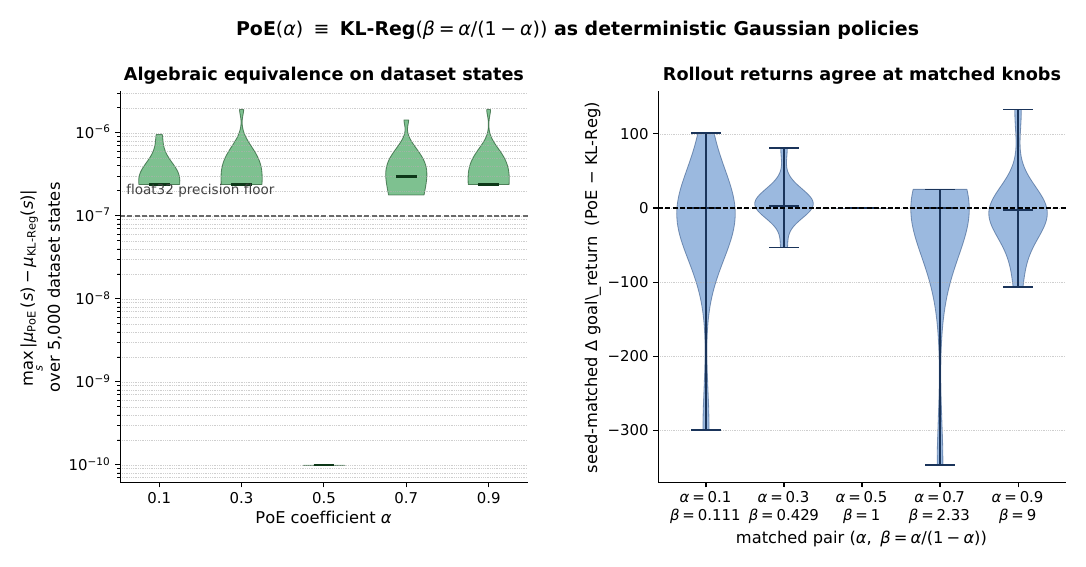
Figure 1. Empirical check of the identity. Left: |μPoE − μKL-Reg| over 5,000 dataset states per α (log scale; dashed line is float-32 precision). Right: seed-matched rollout return differences at each matched (α, β) pair, pooled over all 12 cells.
Steering is not a free improvement. With ten seeds the 12 headline cells split evenly: 4 help, 4 tie, 4 hurt (five seeds: 4/5/3). HalfCheetah ties on every goal. The speed goal G1 hurts wherever the actor is already near its velocity ceiling.
| Setting | Goal | Δ (5 seeds) | Δ (10 seeds) | CI half-width (10 seeds) | Verdict |
|---|---|---|---|---|---|
| HalfCheetah-M | G1 speed | +247.6 | +232.1 | 359.2 | Frozen |
| HalfCheetah-M | G2 balanced | +167.5 | +135.2 | 186.4 | Frozen |
| HalfCheetah-M | G3 control | +29.0 | +29.0 | 50.0 | Frozen |
| Hopper-M | G1 speed | −291.0 | −338.6 | 45.4 | Hurt |
| Hopper-M | G2 balanced | +143.8 | +147.6 | 30.4 | Help |
| Hopper-M | G3 control | −4.6 | −11.0 | 6.3 | Frozen → Hurt |
| Walker2d-M | G1 speed | −2,029.9 | −2,013.8 | 159.8 | Hurt |
| Walker2d-M | G2 balanced | +123.5 | +86.4 | 101.6 | Frozen |
| Walker2d-M | G3 control | +55.4 | +22.4 | 21.3 | Help |
| Hopper-ME | G1 speed | −877.8 | −892.0 | 55.8 | Hurt |
| Hopper-ME | G2 balanced | +54.5 | +74.7 | 37.2 | Help |
| Hopper-ME | G3 control | +110.2 | +112.4 | 7.6 | Help |
Table 1. Best-in-family composition minus frozen actor, in goal-weighted return. The only verdict that changes with ten seeds is Hopper-medium G3, which moves from a tie to a small hurt (Δ = −11.0 against ε = 6.3).
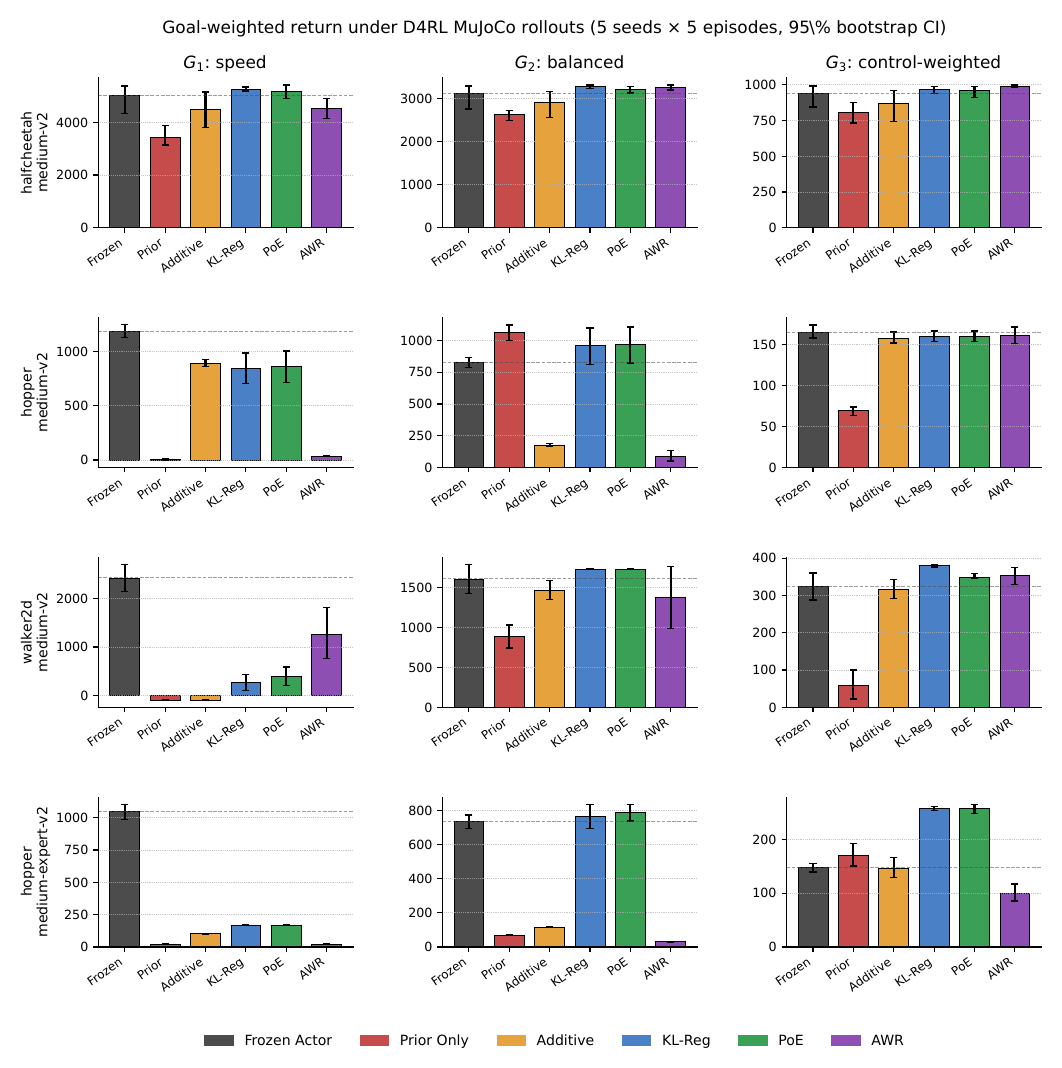
Figure 2. Headline rollouts: mean goal-weighted return with 95% bootstrap CIs, 25 episodes per cell. Rows are settings, columns are goals; each composition family is shown at its best operating point.
This is the paper's strongest practical result. We replace the trained prior with undertrained, noisy (σ = 0.05 parameter noise) and random versions. Prior-only and additive deployment collapse. Precision-weighted composition stays close to the frozen actor, because a degraded prior has low precision and the posterior mean shrinks back toward the actor.
Under the noisy prior the order holds (Prior only 193.8, Additive 362.0, PoE/KL-Reg 639.6), and under the undertrained prior too (200.4 / 753.3 / 1,110.0). A random prior can even score above the trained one, but only because it is ignored: mean KL to the frozen actor is 0.61 under the random prior versus 10.4 under the trained one.
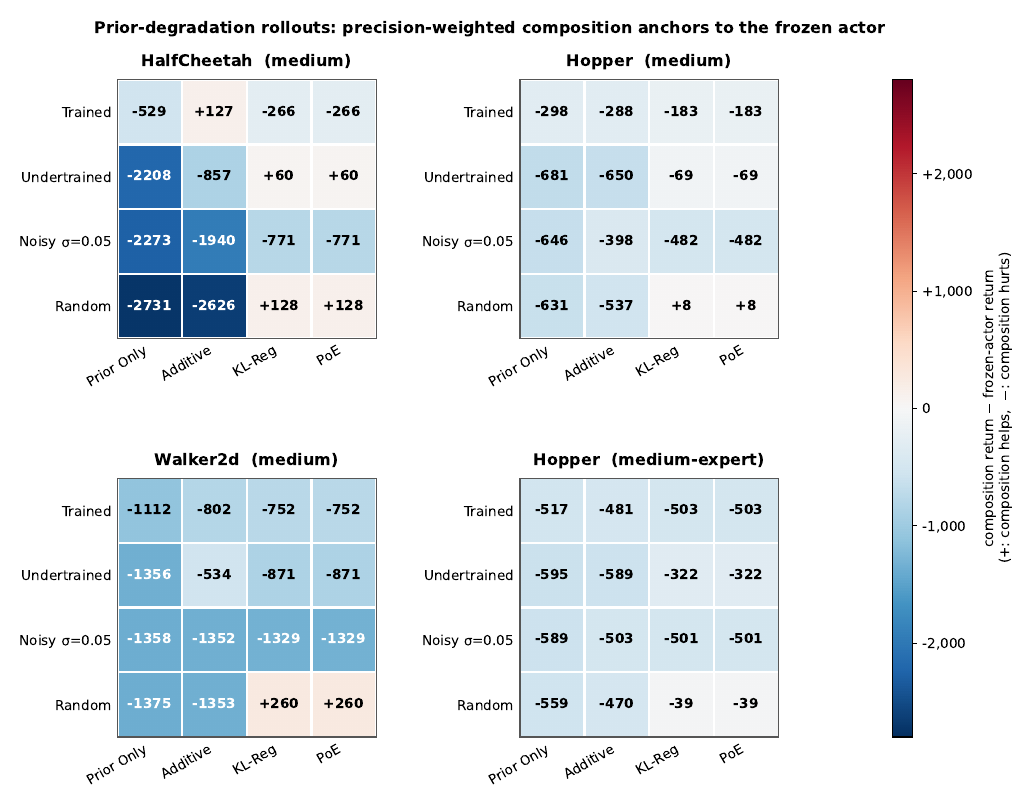
Figure 3. Prior-degradation rollouts at a fixed operating point (PoE α = 0.5, matched KL-Reg β = 1, Additive λ = 0.5), shown as composition minus frozen-actor return, averaged over goals. The comparison that matters is within a row: under the same random prior, Prior Only and Additive collapse while PoE/KL-Reg do not.
A KL-budget rule picks the strongest steering (smallest α) whose mean dataset-state KL from the frozen actor stays within a budget κ. It needs only the dataset, the actor and the prior. On halfcheetah-medium-v2 (scored with the off-policy diagnostic evaluator, not rollouts), its loss against the hindsight-best α is at most 0.020 across κ ∈ {0.1, 0.3, 0.5, 1.0} and all goals, and zero at κ = 1.0. κ is a deployment design choice, trading goal-directed gain for proximity to the validated actor.
Does turning the knob fix the hurt cells? No. An α sweep over six harder settings (medium-replay and medium-expert for each locomotion task, 5,850 episodes) shows the boundary is set by how competent the frozen actor is, not by α. The equivalence still holds: at α = 0.5, |μPoE − μKL-Reg| is exactly 0 in all 18 cells.
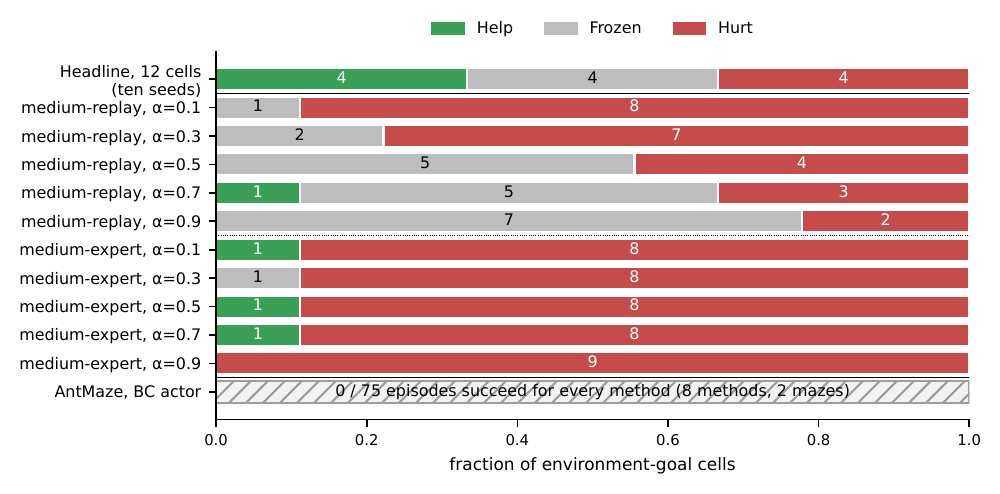
Figure 4. Help / Frozen / Hurt counts for the 12 headline cells (ten seeds) and for every harder-regime cell–α combination (9 cells per row). Medium-replay drifts toward ties as α grows; medium-expert stays hurt at every α. Walker2d medium-expert is the clearest case: the frozen actor reaches 4,920 on G1, while PoE falls to {399, 72, 62, 63, 78} across α. Near the locomotion ceiling, even small precision-weighted shifts push the action off the high-support ridge.
AntMaze BC actors that never reach the goal solve 0 of 75 episodes, and every method inherits that zero. With six umaze actors at 39–67% success, PoE/KL-Reg keep 24–69% while Prior Only collapses to 0%, but composition never beats the frozen actor.
On pen-human, composition preserves a moderately competent actor (a tie on every goal at α = 0.9) while prior-only and additive steering hurt, with additive at 0% success. On hammer-human, where the actor is incompetent, no method succeeds.
Swap the contrastive prior for one trained by advantage-weighted regression and the headline split moves from 4/5/3 to 4/8/0: no cell hurts, and Hopper medium-expert G1 goes from −878 to +117. The hurt cells come from a near-ceiling actor combined with the contrastive prior.
Critic-guided steering is a strong option when a reliable critic is affordable, validated, and its β can be tuned. It is not our default for governed deployment: its best β was picked per cell from realized returns with no rollout-free selector, single-β operation is fragile, it inherits critic error directly, and a critic in the action path is heavier to revalidate than a one-knob reweighting.
| Method | Help / Frozen / Hurt | Needs a critic | Closed-form ≡ | What it falls back on |
|---|---|---|---|---|
| PoE / KL-Reg (best α) | 4 / 5 / 3 | No | Yes | The frozen actor, when the prior is weak |
| CQL-guided (best β) | 5 / 7 / 0 | Yes | No | The critic, errors included |
| IQL-guided (best β) | 6 / 6 / 0 | Yes | No | The critic, errors included |
| Critic-gradient (AWR/AWAC-style) | improves 3 of 12 | Yes | No | A raw ∇aQ step, off-support |
Table 2. Five-seed splits on the 12 headline cells, each family swept over its knob (α ∈ {0.1,…,0.9}; β ∈ {0.5, 1, 3}) and shown at its best value per cell. The critic-gradient step falls more than 100 return points below Frozen in 7 cells once it leaves the data support. At β = 1.0, IQL collapses to about 5 return on all three harder-regime hopper medium-expert cells. An SF/GPI baseline is competitive on HalfCheetah but fragile on Hopper and Walker2d.
A dataset-only sensitivity score S, the closed-form mean KL between the α = 0.5 composition and the frozen actor on dataset states, ranks steering risk without any rollouts. On the 12 headline cells the three five-seed hurt cells score highest (min hurt 5.06, max non-hurt 4.96; Spearman −0.77, p = 0.003 against return deltas; pooled over 30 cells −0.67, p < 10−4). The separation is retrospective and imperfect, and no threshold transfers across regimes, but it suggests a simple procedure:
Near-zero offline success (as in AntMaze) is a dataset-visible sign that no reweighting will help.
A large S means steering moves the validated actor far. Actor–prior log-density mismatch and the actor's normalized-return saturation point the same way.
Pick α with the KL-budget rule. The worst case of a bad prior is staying close to the actor you already validated.
Theorem 1 (variational optimality): with finite actions, PoE is the unique maximizer of Eπ[α log πθ + (1−α) log ρφ] + H(π) on the common support. Theorem 2 splits the return change into a one-step advantage gain minus a total-variation deviation penalty with coefficient 2γ/(1−γ)2, which is 19,800 at γ = 0.99. That makes the bound vacuous as a predictor, and we do not use it to classify cells. Its value is the reading it gives: help cells pair a useful gain with small deviation, hurt cells pair a small gain with deviations that leave the region of reliable behavior.
If you find this work useful, please consider citing: